

In this section of the Guide, we are exploring when a load-based fee should be applied.
In a recent episode, we discussed the Manhattan charge cordon – a scheme designed above all to raise revenue. When a scheme has this aim, the answer to the question of when to charge a fee, is always. In Manhattan the cameras are on every hour of every day.
Our exploration sought to compare this 24/7 revenue raising charge with one that might apply in a parallel universe, one where the scheme aimed to prevent the Manhattan road system from being over-loaded.
When a scheme aims to prevent the system from being over-loaded, the answer to the question of when to charge a fee, is whenever the load puts the system under stress. Since loads typically vary, rising from low in the wee small hours to high at other times, we would expect the fees in a load-based scheme to vary across the days and hours. We would also expect to see a fee of zero dollars during the hours when the system can easily accommodate the load.
Our comparison between the actual revenue raising system and the imagined load-based system was based on actual load data. We are fortunate that before the MTA introduced the charge, they observed the inbound and outbound loads and published the data. You can see on this chart the load is sometimes low and sometimes high. (The colour bands and categories have been added to the MTA base chart.)
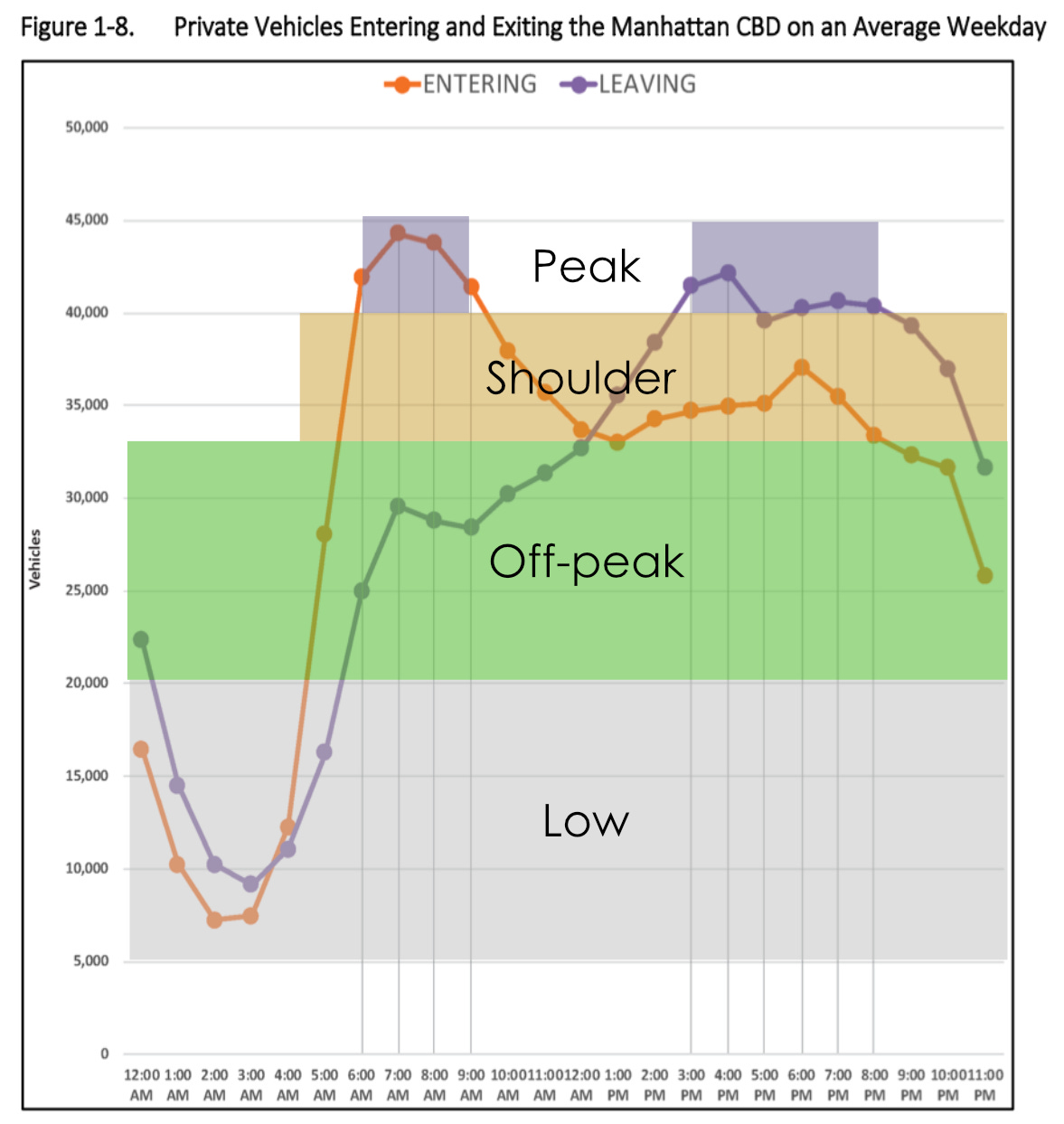
Many revenue raising schemes charge a flat fee 24/7. We see this in Australia, on the private revenue raising toll roads. There we observe the loads going up and down, while the fee remains the same. In Manhattan, the observed inbound loads had some influence on the fees set by the MTA as the authority uses two fees rather than one. The low fee called Overnight applies (21:00 – 05:00). A higher Peak fee applies at all other times.
Rather than two load levels, our investigation found that the pre-cordon load in Manhattan had four levels. We called these four periods Peak, Shoulder, Off-Peak and Low. In your imaginary scheme you might introduce more categories.
In a load-based system, each level of load requires its own fee. So, in the parallel universe, we imagined a scale of four fees for Manhattan. Between the MTAs Peak and Overnight charge, we inserted a mid-point fee (Shoulder). We renamed the Overnight charge Off-peak and then added a fourth fee of zero dollars to apply when the stress of the load on the system was Low.
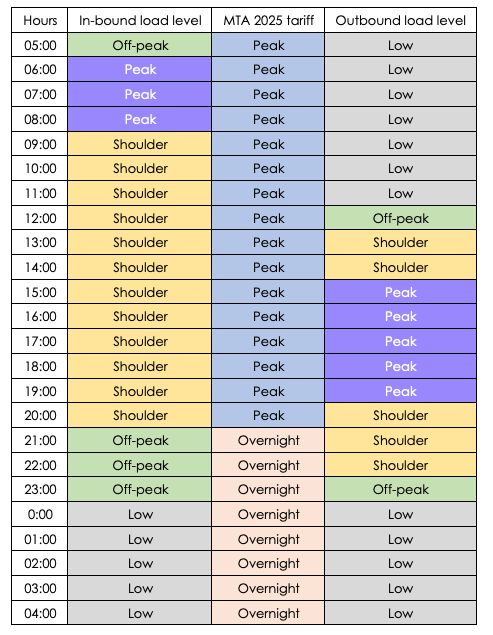
This table compares the four-category load with the two-load, two-fee system introduced by the MTA.
Inbound flows
You can see on the Table that in Manhattan the inbound peak is 06:00 – 09:00. The higher MTA fee (shown in the middle column) applies from 05:00. This pre-emptive start might also be observed in a load-based scheme. When a load rises quickly to stress the system stress (as does the Manhattan load), a fee applied at the beginning of the period of stress (06:00 in this case) might merely shift the stress to the previous hour. To prevent this, the Singapore scheme leans a stepladder of fees in front of the peak fees, lifting the fee in each time-band by 50¢ or $1 until the peak fee is reached.
In Manhattan, the inbound load falls from the Peak at 09:00. The MTA, however, to meet its revenue raising goal, keeps charging the highest fee. A load-based scheme would still charge during these hours as the load remains high, but the fee would be at a lower level than at the Peak.
When the inbound load falls further at 21:00, the MTA switches the charge to the lower rate. A load-based scheme would also lower the fee at this point.
Finally, at midnight, the inbound load drops to Low. At this point, a load-based scheme would switch off the cameras. The MTA of course continues to collect revenue.
We could perhaps see the inbound charge levied by the MTA as a revenue-hungry version of a load-based charge – a scheme that adjusts the fee at (some) times when the load changes, but mostly overcharges, especially in the wee small hours.

Outward bound
The same assessment could not be made of the MTA treatment of the outbound flow.
The Manhattan load is asymmetric. The inbound and outbound loads differ greatly. The inbound profile rises quickly and tails off gently. The outbound profile climbs steadily, then steadily falls. The higher loads in each direction have a different duration. Inbound, the higher loads endure most of the day. Outbound the stressful loads occupy less than half the day. The outbound load level changes six times (in our definition), the inbound load only five. In each direction, change of load level occurs at different hours (except when both inbound and outbound flows drop to Low load at midnight).
With this load pattern and a load-based system, you would expect an asymmetric tariff, one that applied different fees at the same hour depending on whether you were inbound or outbound. You find this asymmetry in Singapore. There, some gantries are on the morning and not in the afternoon. Others are not active in the morning but turn on to respond to stress in the evening. A handful impose a charge in both periods.
This tailored approach is not what we find in Manhattan. Indeed, the outbound flows are not subject to a charge at all.
The Manhattan system is based on a day pass that must be purchased when entering the cordon. No charge applies in the outbound direction. This approach efficiently secures the day’s revenue in a single transaction. It also cuts the number of cameras and gantries needed by half.
Under this mechanism, drivers based inside the cordon must pay when they travel beyond the cordon. But only on their return.
This revenue collection mechanism makes the outbound driver indifferent to the hour of their departure. In a load-based system, the driver based inside the cordon would see a tariff that encouraged them to leave before midday. After that hour, the load begins to increase towards the outbound Peak. Drivers based outside the cordon and on their way home have no incentive to avoid the outbound Peak (16:00 – 20:00).
In summary, in Manhattan, the cordon applies a charge to inbound drivers in a manner and at a rate not unlike what might apply in a system that seeks to moderate the load. On the other hand, and in the other direction, the day-pass mechanism which applies no-charge to an outbound trip is nothing like the charge that would apply under a load-based system.

We can imagine three reviewers reporting on the Manhattan scheme.
The reviewer inspecting the cash register would see that the scheme was meeting its revenue targets and approve of the current settings. This reviewer would be open to a fee increase in the future (as the MTA is contemplating).
The reviewer looking for evidence of harm reduction through the discouragement of vehicle trips would also be pleased. They would note the high fees that apply (inbound) for nearly two thirds of the day. They would approve the no-exceptions rule that levies the charge not only on inbound drivers but also on those who start their journey outbound. They would endorse the equally discouraging fees faced by outbound and inbound drivers. The discourager would be open to a fee increase to further squeeze motor vehicle trips.
The reviewer considering the MTA scheme from the perspective of the load would be pleased with the data that shows the charges have reduced the load sufficiently to increase the flow speed by ~11%. These higher speeds will have generated time savings for individual drivers. Importantly the higher speeds will (to some extent) have freed buses and other road-based public transport from delay increasing reliability and reducing travel times.
The load reviewer would be critical of the scheme’s lack of a price signal to influence outbound flows, especially at Peak times. They would also note that for many hours the scheme is charging higher fees than needed to keep the load below an optimum level. (A setting that pleases both the revenue and discouragement reviewers.) In a load-based scheme, to charge a high fee when the load is low is overcharging.

When considering whether to suppress the load and by how much, the three reviewers would find themselves in a series of shifting alliances.
When the system is heavily over-loaded, all can agree (for different reasons) that a charge should be applied.
If, after the first fee has been applied, suppression is modest, the revenue raiser might be happy. At this point, total revenue is probably optimum. The revenue raiser would be nervous about a fee increase as too much suppression will, at some stage, reduce the number of people willing to pay the fee.
If suppression is modest, the discourager and the load modifier might join forces in support of higher fees. Any increase in fees will please the discourager. The load modifier will want to bring the load down to where the system can cope, and free flow is restored.
If after the increased fee has been applied, the system is in free flow, the load modifier will be against further unnecessary fee increases. When fees are too high, the roads and tunnels become unnecessarily empty, wasting the investment in land and capital. The load modifier will also oppose the revenue raiser charging people who are already in free flow.
In the struggle for a still-higher fee, the discourager will be on their own. The load modifier will not want to levy fees unnecessarily and the revenue raiser will dislike the option of a high fee paid by a few.

Let us see who won the (imaginary) argument on Sundays at the Holland Tunnel. This tunnel links New Jersey to the west with the Manhattan congestion zone.
The cordon controls are somewhat loosened in this location and on weekends.
The fee in the Tunnel (and a handful of other locations) is discounted. The full charge at other cordon crossings is $9 US. Drivers inbound through the Tunnel can get a $3 credit for autopay. This lowers the fee to $6 US or ~$10 AUD.
The weekend time bands also vary. Rather than its weekday start time of 05:00, on the weekend the Peak fee sleeps in until 09:00.
In the chart below the pre-cordon load is the blue line, the post-charge load is red.
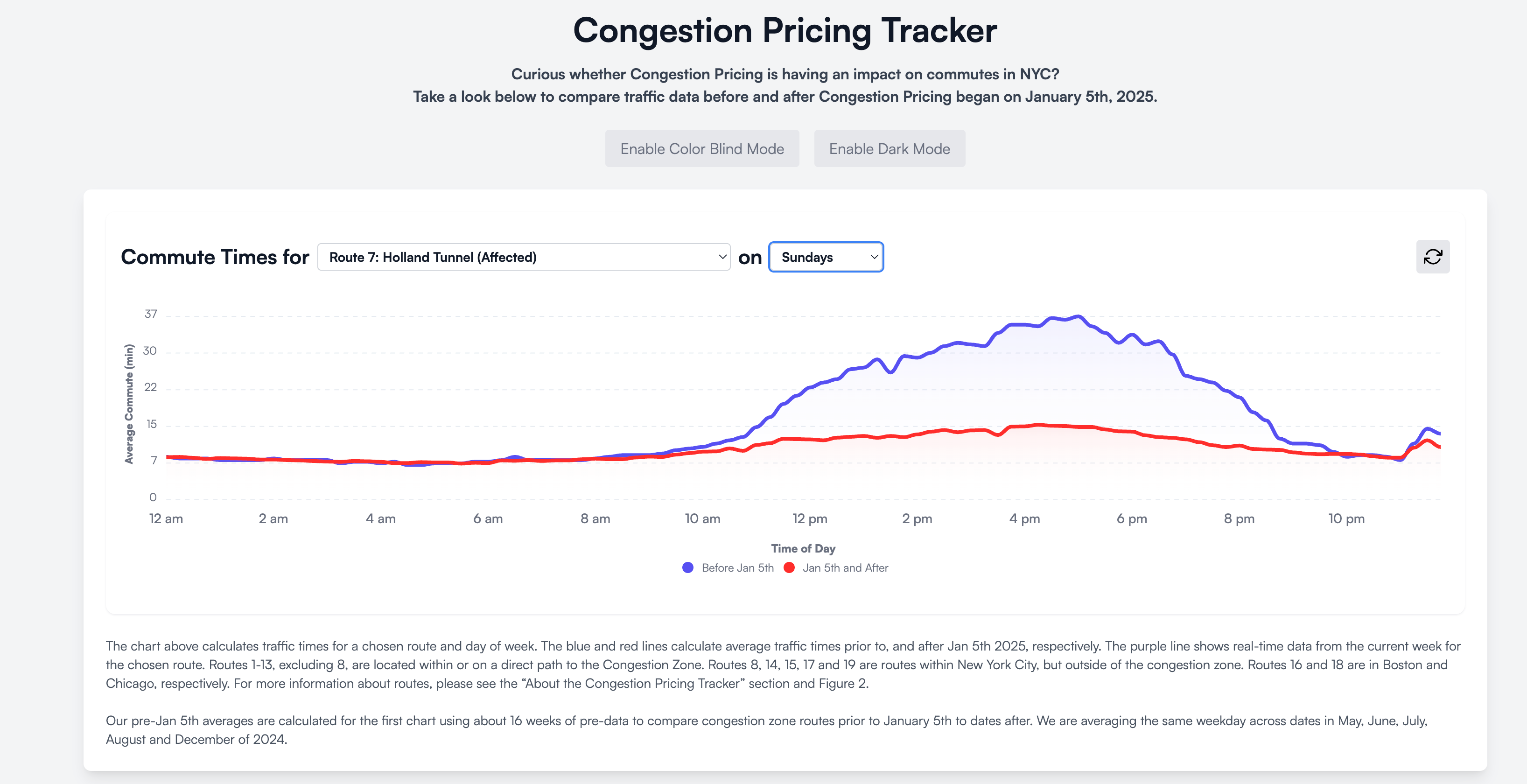
You can see the later starting Peak fee comes into effect just as the pre-cordon load (blue line) was starting to take off. Here again we see the MTA aligning the tariff to reflect changes in the inbound load.
This lower and later starting Peak fee has squashed the load. Pre-charge, the maximum load was 37,000 but now it is less than 10,000 vehicles per hour. The discouragers would be pleased.
Someone running a revenue raising scheme would look at those results and wonder if they could raise more money by applying a lower charge to a greater number of vehicles. Instead of 7,000 people paying $6, you could charge 10,000 people $5 or 15,000 people $4. Lower fees and higher loads would lift revenue per hour from $42,000 to $50,000 or $60,000.
A load-based tariff designer would also be critical. On Sundays, there must be a lot of unused space in that tunnel. The load optimiser would ask why the load must be held at 7,000 vehicles an hour. Perhaps 10,000 or 15,000 vehicles can go through the tunnel without the system clogging up. Nor, they would note, does it seem necessary to charge a fee overnight when the pre-cordon load was already so low.
If you know someone who would find this episode interesting, send them a link.